
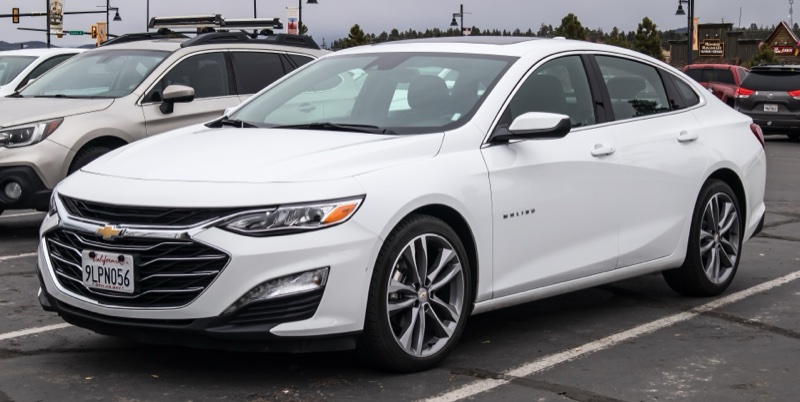
U0001 on Chevrolet Malibu
Factory diagnostic protocol and troubleshooting wire for fault code U0001 specifically for the Chevrolet Malibu (2020–2024, 1.5L Turbo 4-Cyl (163HP) / 2.0L Turbo (227HP)).
1. Symptoms of U0001 on Chevrolet Malibu
When the Engine Control Module (ECM/PCM) on your Chevrolet Malibu (1.5L Turbo 4-Cyl (163HP) / 2.0L Turbo (227HP)) logs fault code U0001, drivers commonly observe:
2. Most Likely Causes on Chevrolet Malibu
Historical warranty claims and technical repair bulletins for Chevrolet Malibu point to the following failure distribution:
3. Step-by-Step DIY Repair Guide for Chevrolet Malibu
Turn ignition OFF, wait 5 minutes for bus to sleep. Measure resistance between Pin 6 (CAN-H) and Pin 14 (CAN-L) on the 16-pin OBD-II port. Normal is exactly 60 ohms (two 120-ohm terminating resistors in parallel). on the Chevrolet Malibu equipped with 1.5L Turbo 4-Cyl (163HP) / 2.0L Turbo (227HP).
If meter reads 120 ohms, one terminating resistor/module is disconnected. If meter reads 0 ohms, CAN-H and CAN-L are shorted together. If meter reads OL (infinite), bus is completely open. on the Chevrolet Malibu equipped with 1.5L Turbo 4-Cyl (163HP) / 2.0L Turbo (227HP).
Turn key ON. CAN-H should measure ~2.7V; CAN-L should measure ~2.3V (summing to 5.0V). on the Chevrolet Malibu equipped with 1.5L Turbo 4-Cyl (163HP) / 2.0L Turbo (227HP).
If bus voltage is grounded or pegged, unplug modules (ABS, BCM, TCM, Radio) one at a time until bus resistance and voltage restore. on the Chevrolet Malibu equipped with 1.5L Turbo 4-Cyl (163HP) / 2.0L Turbo (227HP).
Repair pinched twisted-pair wiring or replace the defective module causing network collision. on the Chevrolet Malibu equipped with 1.5L Turbo 4-Cyl (163HP) / 2.0L Turbo (227HP).
Equipment for Diagnosing Chevrolet Malibu (U0001)
Chevrolet Malibu OEM Replacement Sensor
Direct-fit replacement assembly engineered to OEM tolerances for Chevrolet Malibu.
AstroAI Auto-Ranging Digital Multimeter
Essential for testing 0.1V–5.0V sensor reference signals, ground continuity (<0.20Ω), and harness resistance.
BlueDriver Bluetooth Pro OBDII Scan Tool
Reads and clears enhanced codes (ABS, Airbag, Transmission, Engine) & live freeze-frame telemetry on phone.
Other Common Fault Codes on Chevrolet Malibu
Frequently diagnosed powertrain, emissions, and sensor trouble codes logged on the Chevrolet Malibu:
4. Chevrolet Malibu U0001 FAQs
What causes code U0001 to trigger on a Chevrolet Malibu?
On the Chevrolet Malibu (1.5L Turbo 4-Cyl (163HP) / 2.0L Turbo (227HP)), U0001 is most frequently caused by Short circuit to ground or short to power on CAN-High (Pin 6) or CAN-Low (Pin 14) or Terminating resistor open or missing in ECM or Cluster (60 ohms nominal across bus).
Where is the OBD-II port located on my Chevrolet Malibu?
On the Chevrolet Malibu, the 16-pin DLC diagnostic connector is located Under driver dash, above brake pedal cluster. Plug in any standard OBD-II scanner with the ignition in the ON position to read freeze-frame parameters.
Can I safely drive my Chevrolet Malibu with code U0001?
No. High-Speed CAN bus failure disrupts communication between the Engine, Transmission, ABS, and Instrument Cluster. Given that U0001 carries a Critical severity rating, we advise avoiding heavy towing or aggressive throttle inputs until sensor readings are verified.